
2026.08.03
Favorable Views Toward South Korea Have Improved, but Trust Remains Low. Japanese Public Opinion Recognizes the Need for Practical Cooperation. Announcing the Preliminary Report of the Japan-South Korea Joint Opinion Poll
Share


News Category
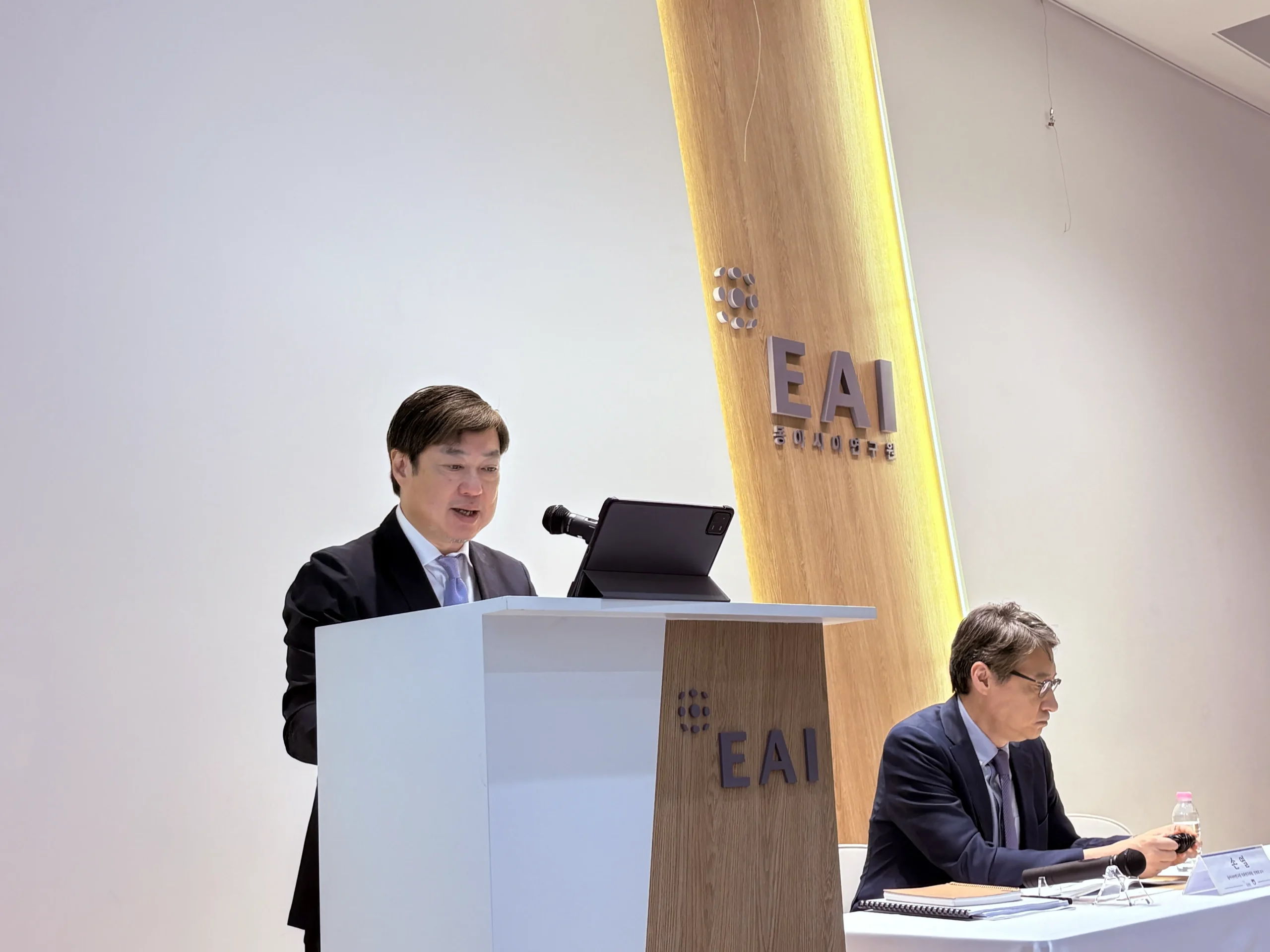
The International House of Japan (Minato-ku, Tokyo; Chairman: James Masaaki Kondo, hereinafter referred to as “IHJ”) has conducted the “Japan-South Korea Joint Opinion Poll” (hereinafter referred to as “this survey”) in collaboration with the East Asia Institute (EAI) in South Korea. This morning, August 3, a joint press conference was held at the EAI in Seoul to announce the survey results for both countries. This preliminary report presents the main findings from the Japanese portion of the survey.
This survey marks the first bilateral public opinion poll jointly conducted by IHJ and EAI in both Japan and South Korea. In 2025, a joint survey involving Japan, the United States, and South Korea—with the addition of the Korea Economic Institute of America (KEI, based in the U.S.)—was conducted; this latest survey focused on Japan-South Korea relations, trilateral security cooperation among Japan, the U.S., and South Korea, Japan’s defense, and perceptions of the U.S., China, and Taiwan.
Going forward, IHJ and EAI will sequentially release the materials used by EAI during the joint press conference, detailed analysis reports, and reports on the public forum, among other documents.
Details will be posted on our website.
| Response Period | Japan:Friday, July 17, 2026 – Tuesday, July 21, 2026 South Korea:Monday, July 20, 2026 – Tuesday, July 21, 2026 |
| Number of Responses | Online Survey Japan:1,552 responses South Korea:1,547responses |
| Survey Overview | The survey comprised 53 questions covering the following four areas, 47 of which were asked in collaboration with EAI. ・Japan–South Korea Relations ・Japan–U.S.–South Korea Security Cooperation ・Perceptions Regarding Japan’s Defense ・Perceptions of the U.S., China, and Taiwan |
Japan-South Korea Joint Opinion Poll
Survey results summary from Japan
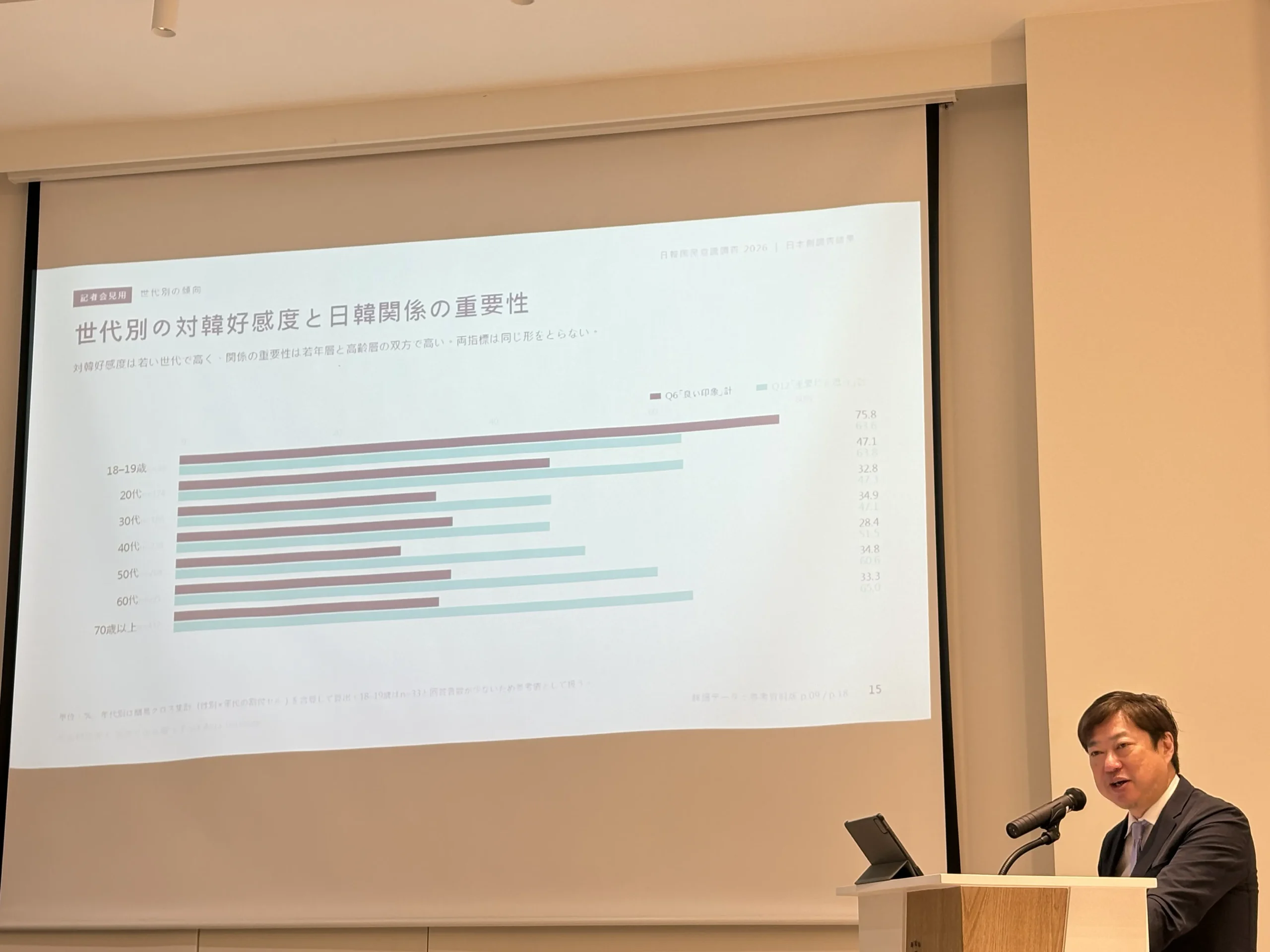
On August 3rd, Ken Jimbo (Managing Director of IHJ) delivered a speech at a joint press conference held at the EAI in Seoul, South Korea, to report on the results of the Japanese survey.
Please note that the percentages in this preliminary report are calculated based on the actual number of responses and are rounded to the nearest whole number (to the first decimal place). For this reason, the sum of the displayed values may not match the total. Additionally, for questions allowing multiple answers, the total may exceed 100%.
1. Japan-South Korea Relations
- Regarding sources of information on South Korea and Japan-South Korea relations (up to two answers allowed), both new media (59.1%) and traditional media (53.2%) exceeded 50%.
- The combined percentage of respondents who had a “good” or “somewhat good” impression of South Korea was 35.3%, up 10.5 percentage points from last year’s 24.8%. However, those with a “not good” or “somewhat not good” impression stood at 44.1%, still exceeding the percentage of good responses. Among those with a good impression, the main reasons cited were South Korea’s appeal as a travel destination (53.6%) and its popular culture (50.7%); among those with an unfavorable impression, the primary reason was “because I feel there is strong criticism of Japan and anti-Japanese sentiment in South Korea” (49.3%). Regarding impressions of President Lee Jae-myung, “neither favorable nor unfavorable/don’t know” (55.3%) was the most common response. Furthermore, only 24.5% of respondents viewed South Korea as a “trustworthy partner,” which was lower than the 50.2% who viewed it as “untrustworthy.”
- The largest group, at 52.5%, described current Japan-South Korea relations as “normal.” Meanwhile, 57.0% of respondents considered Japan-South Korea relations “important” for Japan, exceeding the 26.5% who considered them “unimportant.” Among those who considered the relationship “important,” the main reasons cited were “the need for security cooperation” (57.7%) and “geographical and cultural ties” (44.0%); among those who considered it “not important,” the top reasons were “the lack of progress on historical issues, making it difficult to strengthen relations” (42.6%) and “differences in values regarding diplomacy, judicial decisions, and public opinion” (35.3%).
- Regarding Japan-South Korea relations over the next 3 to 5 years, “not much different from the present” was the most common response at 49.2%, while “don’t know” accounted for 23.8%. Regarding priorities for the future, the top responses were: “Strengthening cooperation in the field of security to address issues such as North Korea’s nuclear and missile programs” (30.2%), “Restoring and building a relationship of trust between Japan and South Korea” (29.0%), and “Expanding people-to-people exchanges and mutual understanding, particularly among the younger generation” (26.4%).
- Regarding the relationship between historical issues and cooperation, 17.6% agreed that “cooperation between Japan and South Korea will not progress unless historical issues are fully resolved.” On the other hand, 32.6% agreed that “even if historical issues remain, moving forward with cooperation will bring us closer to a resolution,” while 32.0% agreed that “resolving historical issues is difficult regardless of whether cooperation takes place,” with the two views being evenly split; 17.8% responded “don’t know.” Furthermore, a combined 67.5% of respondents considered the Takeshima (Korean name: Dokdo) issue to be “important” or “somewhat important.”
- 29.7% expressed “interest” in South Korean popular culture, which was lower than the 61.3% who expressed “no interest.” However, 87.4% of those interested (461 people) responded that popular culture helps improve South Korea’s image in Japan.
- The areas of interest were, in order, dramas, movies, and variety shows (70.7%), K-POP (54.0%), and fashion and beauty (37.1%); 65.9% of those interested stated that even if Japan-South Korea relations deteriorated, their enjoyment of South Korean popular culture would remain unchanged.
- 40.8% of respondents viewed Japan-South Korea economic relations as “mutually complementary,” surpassing the 28.2% who viewed them as “competitive.” Regarding the future of economic cooperation, “unsure” (32.3%) was the most common response, followed by “the current level is appropriate” (23.3%) and “free trade and an open trade order should be established through South Korea’s accession to the CPTPP, etc.” (22.0%). The proposal to strengthen cooperation by combining South Korea’s accession to the CPTPP with the establishment of a Japan-South Korea economic community received 31.4% of the vote. Among the 487 respondents who selected a proposal to strengthen cooperation, the most common reason cited was “Japan-South Korea cooperation is necessary amid U.S.-China tensions and friction” (43.5%).
2. Japan-U.S.-South Korea Security Cooperation
- In preparation for security crises in East Asia, responses indicating that “institutionalized Japan-U.S.-South Korea cooperation” (24.9%) or “practical cooperation between Japan and South Korea, including the ACSA” (22.7%) should be promoted accounted for a combined total of 47.7% of the total number of responses. The combined total of those who believed “cooperation should be limited to information sharing and policy consultations” and those who believed “security cooperation between Japan and South Korea should not be pursued” was 23.9%, while 28.5% responded “I’m not sure.”
- Support for strengthening security cooperation among Japan, the U.S., and South Korea stood at 51.2%, remaining virtually unchanged from the 51.7% recorded in 2025. Among those in favor (794 respondents), the main reasons cited were “curbing China’s military rise” (56.9%) and “addressing North Korea’s nuclear and missile threats / stabilizing the Korean Peninsula” (55.0%). Among those opposed (315 respondents), the most common reason was “the difficulty of building trust due to differences in historical perceptions between Japan and South Korea” (43.5%).
3. Perceptions Regarding Japan’s Defense
- Regarding Japan’s possession of nuclear weapons, 49.9% were opposed, 29.9% were in favor, and 20.2% responded “don’t know.” Regarding South Korea’s possession of nuclear weapons, 57.4% opposed it, 17.7% supported it, and 24.9% responded “Don’t know.” While opposition exceeded support in both cases, caution is needed when making simple year-over-year comparisons, as the wording of the question and the central response options were changed from the previous year.
- Regarding the review of rules on the overseas transfer of defense equipment, 41.3% were in favor, exceeding the 26.6% who opposed it. “Can’t say/Don’t know” accounted for 32.1%.
- Regarding the level of defense-related spending (approximately 1.9% of GDP), “The current level is fine” was the most common response at 34.3%, followed by “Don’t know” (27.6%), “Should be reduced” (20.0%), and “Should be increased further” (18.1%).
- Regarding countries and regions perceived as military threats (multiple answers allowed), China (74.9%), North Korea (71.9%), and Russia (59.1%) ranked highest. The United States was also cited by 13.9% of respondents.
- Regarding countries and regions that are economically important to Japan, the United States remained the top choice at 67.9%, remaining virtually unchanged from the previous year’s 66.4%. This was followed by ASEAN (39.5%) and the EU (38.9%). Meanwhile, China dropped 9.5 percentage points from 37.3% to 27.8%, falling from second to sixth place.
4. Perceptions of the U.S., China, and Taiwan
- Regarding the impression of the U.S., 39.0% of respondents rated it as “good” or “somewhat good,” while 38.3% rated it as “not good” or “somewhat not good” (based on the combined total of actual responses), with the two groups being roughly evenly split. There was no significant change from the previous year (good: 40.5%, not good: 34.5%). The percentage of respondents who rated President Trump as “not good” or “somewhat not good” was 70.9%, remaining virtually unchanged from the previous year’s 70.1%.
- The largest group, at 49.3%, described current Japan-U.S. relations as “normal.” The percentage of respondents who viewed the U.S. as a “trustworthy partner” was 34.7%, falling short of those who viewed it as “not trustworthy” (47.0%).
- 52.9% of respondents said the U.S. should continue to support a global economic order based on free trade, exceeding the 17.9% who said it should not. “Don’t know” responses accounted for 29.2%.
- Only 5.6% of respondents rated the impression of China as “good” or “somewhat good,” while 81.1% rated it as “not good” or “somewhat not good.” Similarly, 79.0% of respondents rated President Xi Jinping as “bad” or “somewhat bad.”
- 76.3% of respondents described current Japan-China relations as “bad” or “somewhat bad.” Additionally, 83.7% viewed China as an “untrustworthy partner.” Meanwhile, regarding future policy toward China, the most common response—at 44.3%—was that Japan should “continue dialogue with China while addressing security concerns.”
- Regarding Taiwan, 74.5% rated the impression as “good” or “somewhat good,” while 5.7% rated it as “not good” or “somewhat not good.”
- Regarding the likelihood of a military conflict or crisis occurring in the Taiwan Strait within the next few years, “Don’t know” was the most common response at 43.6%, followed by “I think there will be one” at 36.9% and “I don’t think there will be one” at 19.6%. Compared to the previous year, the percentage of those who “think there will be one” decreased from 42.1% to 36.9%, while those who “don’t know” increased from 39.2% to 43.6%. Meanwhile, 75.8% of respondents considered a crisis in the Taiwan Strait to be “important” or “somewhat important” to Japan’s national interests. The most serious impact cited was “security risks to the Nansei Islands” (25.9%), followed by “economic losses due to disruption of maritime transport routes” (18.9%).
- Regarding Japan’s involvement, 22.5% said Japan “should respond in cooperation with the United States, including the use of force by the Self-Defense Forces,” 21.8% said “don’t know,” and 20.8% said Japan “should avoid the use of force by the Self-Defense Forces and instead provide logistical support to U.S. forces in Japan.” In addition, “non-military measures such as diplomacy, economic sanctions, and humanitarian aid” accounted for 14.1%, “limited to information sharing, surveillance, and strengthening defense around Japan” accounted for 11.7%, and “Japan should not get involved” accounted for 9.0%; responses were not concentrated on any single specific policy.
5. Other
- Regarding political party support, “I do not support any political party” was the most common response at 55.2%, followed by the Liberal Democratic Party at 18.8%, Sanseito at 4.4%, and the Japan Innovation Party at 4.3%.
Summary
In this latest survey conducted in Japan, while favorable impressions of South Korea explicitly increased from the previous year, unfavorable impressions still outnumbered them, and trust in South Korea as a partner remained at a low level. Nevertheless, 57.0% of respondents considered Japan-South Korea relations to be important, revealing a disconnect between public sentiment toward South Korea and the functional and strategic importance of the relationship. Among those who had visited South Korea (447 respondents), 79.6% reported that they maintained or formed a good impression after their visit; however, it is important to note that these results are limited to those with visit experience. Regarding historical issues, while only 17.6% of respondents viewed resolution as a prerequisite for cooperation, expectations for a resolution through cooperation were evenly matched by the view that resolution would be difficult regardless of cooperation.
Regarding the United States, while 67.9% cited it as an economically important country or region, only 34.7% viewed it as a trustworthy partner—a figure lower than the 47.0% who viewed it as untrustworthy. Impressions of and trust in China were extremely negative, and its economic importance also declined from the previous year; however, regarding policy toward China, the most common stance was to combine addressing security concerns with continuing dialogue. Regarding Taiwan, while impressions were favorable and the importance of Taiwan to national interests in the event of a crisis was high, responses were divided on the likelihood of a crisis occurring and the extent of Japan’s specific involvement.
Regarding nuclear weapons possession, among Japanese respondents in this survey, opposition outweighed support for both Japan and South Korea. However, since the wording of the question and the response options were changed from the previous year, caution is required when interpreting the results in an annual comparison. Regarding defense spending, the most common response was that “the current level is appropriate,” while support for increases and decreases was nearly equal, and “don’t know” accounted for 27.6%.
Overall, this survey indicates that while improved good views toward South Korea coexist with low levels of trust, there is a certain degree of support for the importance of Japan-South Korea relations and the necessity of practical and security cooperation. It suggests there is room to proceed in parallel with addressing historical issues and practical cooperation. Additionally, vigilance toward China and North Korea, recognition of the gravity of the Taiwan Strait crisis, and the gap between the perceived importance of the United States and the level of trust in it were confirmed as key characteristics of Japan’s perception of the international community.