Built Environment and Lifestyle
The Wooden Metropolis: How Advances in Fireproofing Timber Could Change Urban Japan
Share


- *The program featured on this page has concluded.
Japan’s poor management of its cedar forests, its embracement of concrete to reduce fire risk and a dwindling market for new builds has produced a perfect storm for the domestic timber market. Now, as urban planners call for further eliminating wooden structures from the cityscape to avoid blazes, architects and construction companies are pushing back with innovative fireproofing technologies that could make wooden skyscrapers a reality.
Japan’s unusually fast turnover of buildings—-the average structure in Tokyo is just 20 years old—makes use of steel and concrete environmentally untenable due to the waste they produce. Increased use of wood in construction would also reduce CO2 emissions, which have rocketed since 2011 as Japan burns more oil and gas to make up for an energy shortfall post-Fukushima. Unlike the industrial and distribution sectors, private industry has failed to cut its carbon emissions, of which a large part comes from the construction industry.
Since younger trees absorb more CO2 than older trees, it is vital to maintain the harvesting and replanting cycle in forests. Inhibiting the use of the country’s surplus cedar stocks, however, is a topsy-turvy market in which raw domestic cedar is the world’s cheapest wood but more expensive than imported logs once processed, due to a failure to integrate the production chain.
As a result, domestic wood makes up only 30 percent of the domestic timber market. Japan’s forests are deteriorated and the industry is shrinking because the costs of drying and processing lumber in a complicated supply chain makes it far more expensive than imported wood. Domestic producers also can’t handle large orders within a short time frame unlike European, Canadian or Russian producers, leaving construction firms and home builders reliant on imported timber. As a result, fewer trees are cut down and replanted, less carbon is offset and environmental disasters such as landslides are occurring more frequently.
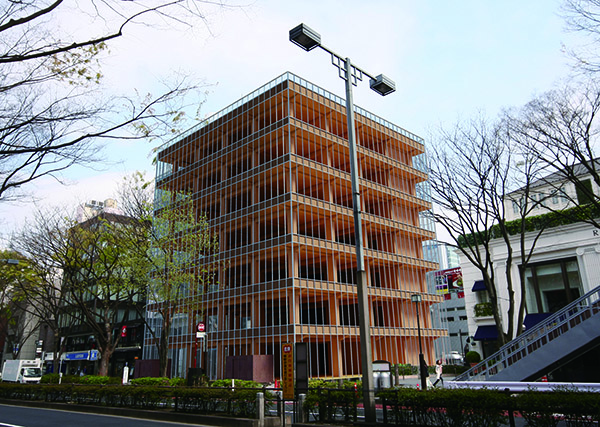
However, there is hope: a revision to the building code in 2000 loosened the regulations on building with wood, making it possible to use exposed timber that employs certain fireproofing technology. Two of Japan’s biggest construction firms, Takenaka Corp and Kajima Corp, have both developed engineered lumber that can withstand one hour of fire, and are aiming to get two-hour versions certified next year. Takenaka used its one-hour timber, trademarked as “Moen-wood”, to build Southwood, Japan’s first wooden shopping mall in 2013 in Yokohama.
More recently, another law has come into effect that obliges local governments to use as much wood in public buildings as possible.
One group taking advantage of the relaxed regulations is team Timberize, an NPO founded by architects going against the grain by proposing multi-story wooden office buildings, apartment blocks and even wooden stadiums and arenas for the 2020 Olympics, while meeting Japan’s stringent—some say excessive—fire regulations. One member of the group was able to build a five-story wooden building in Tokyo in 2013 using another type of fireproofing technology that would allow the structure to burn for one hour without collapsing.
An aversion using wood has spread to the interiors market, too, as companies shy away from using wood in industrial products for fear of customer complaints that it is too easily damaged or irregular. Fighting against that tendency is the 1,800-member strong “Country Covered in Cedar Club”, a consortium of architects and designers trying to increase use of Japanese cedar in wooden furniture and products and boost regional economies by using their surplus cedar stocks. As a result of their efforts, local cedar supplies have been used to build bridges, children’s playrooms and even clad cars on a local train line in Kyushu.

<Interviewees>
Mikio Koshihara: Director of the NPO team Timberize and a professor specializing in timber construction at the University of Tokyo’s Institute of Industrial Science.
Eijiro Kosugi: A director at NPO team Timberize and a professor of architecture at Akita University
Koichi Wakasugi: A product designer at Power Place and the founder of Country Covered in Cedar Club
Kaoru Shibahara: CEO of Nagiso Forestry and supplier of wood for Ise Shrine Alastair Townsend, co-founder of Tokyo-based architectural practice Bakoko
Archives
Program
Built Environment and Lifestyle Dealing with an Aging Population At Home
Innovation
Policy Research
Program
Built Environment and Lifestyle Solutions for the Vacant Home Epidemic
Innovation
Policy Research
Related Programs


Geoeconomics IHJ Roundtable
IHJ frequently organizes roundtables as part of our mission to “contribute to building a free, open, and sustainable future through intellectual dialogue, policy research, and cultural exchange with a...
Policy Research

Innovation Asia Leaders Fellowship (ALF)
ALF was established by Teruhide Sato and Lin Kobayashi, both board members of the International House of Japan (IHJ), along with 5 other founding members. Their awareness of the necessity for a dialog...
Intellectual Dialogue
main-300x200.jpg)