Built Environment and Lifestyle
The Energy Revolution At Home
Share


- *The program featured on this page has concluded.
In response to climate change, the rising cost of resources such as oil and gas, and the increasing risk of both natural and manmade disasters such as Fukushima, various efforts to tackle energy consumption have emerged, from the local to the governmental level.
Some individuals and communities have begun shifting towards “off-grid” lifestyles, generating energy themselves and reducing their dependence on the grid of major utilities such as Tokyo Electric Power Co (TEPCO). Most of these projects depend on solar power and storage batteries. Obviously, such lifestyles require a certain amount of conscious effort.
Requiring somewhat less commitment is the “zero energy house” (ZEH), a commercial answer to Japan’s energy woes. ZEH use solar panels and storage batteries and a well-insulated, airtight construction to ensure that the household produces more energy than it consumes over the course of a year. The reduction in energy bills and tax incentives provided by the government are expected to increase the popularity of ZEH, as well as the “home energy management system” (HEMS) that enables residents to see how much energy they are consuming and to reduce their use of appliances accordingly.
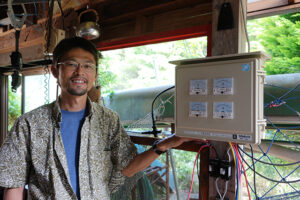
On a larger scale, there are many groups and NPOs promoting local energy projects that generate and distribute energy throughout a community, independent of the major regional utilities. Many of these are detailed in Masaki Takahashi’s “Local Energy Projects Have Started” book, published earlier this year. Takahashi says there are as many as 100 local projects around the country, and emphasizes that the movement has moved beyond a black-and-white dialectic of pro and anti-nuclear camps. We visited one such community project, Fujino Power, based in Kanagawa Prefecture, which teaches workshops on how to make simple solar batteries, orchestrates solar-power music festivals, and installs a solar-power based system in people’s houses that uses Chinese-made panels and car batteries for a tenth of the price that commercial versions of such systems usually cost. Light switches and appliances run off the system are kept distinct from switches that are powered by TEPCO.
Another community-based project is the Sun Self Hotel in Ibaraki prefecture, where an apartment building has been converted into an off-grid hotel by local residents.
Although the Japanese government introduced a system for individuals to sell energy back to the grid in 1992, this scheme only gained attention in 2012, when a fixed price for energy buybacks was decided. However, several regional utilities have said they will stop signing new contracts to buy back solar energy because their grids cannot handle the surges in power, while Prime Minister Shinzo Abe’s administration announced extremely lackluster targets for renewable energy in the government’s 2014 Basic Energy Plan, disappointing those hoping for an energy revolution post-Fukushima.
Interviewees:
Tsuyoshi Seike: Associate professor at the Graduate School of Frontier Sciences, University of Tokyo
Masaki Takahashi: Freelance journalist and author of “Local Energy Projects Have Started”
Shuntaro Suzuki: Project manager of Fujino Power in charge of installing solar systems into local residents’ houses
Kazuaki and Haruko Hashimoto: The latest household to install a Fujino Power system
Archives
Program
Built Environment and Lifestyle Dealing with an Aging Population At Home
Innovation
Policy Research
Program
Built Environment and Lifestyle Solutions for the Vacant Home Epidemic
Innovation
Policy Research
Program
Built Environment and Lifestyle The Wooden Metropolis: How Advances in Fireproofing Timber Could Change Urban Japan
Innovation
Policy Research
Related Programs

Geoeconomics IHJ Roundtable
IHJ frequently organizes roundtables as part of our mission to “contribute to building a free, open, and sustainable future through intellectual dialogue, policy research, and cultural exchange with a...
Policy Research
Innovation Asia Leaders Fellowship (ALF)
ALF was established by Teruhide Sato and Lin Kobayashi, both board members of the International House of Japan (IHJ), along with 5 other founding members. Their awareness of the necessity for a dialog...
Intellectual Dialogue
main-300x200.jpg)