The Nitobe Leadership Program (Nitobe Kokusai Juku in Japanese) started in 2008 to train young professionals from various organizations and corporations to become public-minded leaders, equipped with a broad perspective to function in an international environment both in and outside the country. The program invites professionals of various fields to speak on their experiences, allowing participants (Nitobe Leadership Fellows) to deepen their understanding of such themes as globalization and leadership. This year, Fellows consider the theme, “The World of 2030: Initiatives Toward a New Society.” Some of the lectures are open to the general public.
Nitobe Leadership Program
2016
The Embodiment and Essence of Noh
Share
This program has finished.
- Lecturer: Umewaka Naohiko (Noh master)
- Date: Saturday, October 29, 2016, 1:30-3:00 pm
- Venue: Lecture Hall, International House of Japan
- Language: Only available in Japanese (without English interpretation)
- Admission: Free (reservations required)
Having started in the Muromachi era and having been established in the Edo period, noh has a deep relationship with the Zen idea of mu (nothingness), which is said to be extremely difficult to reach. “Myōkafū,” the acme of performance as defined by Zeami, is expressed in a metaphor similar to a Koan (a paradoxical question for meditation presented to one seeking to learn the secrets of Zen), and it is said that many other theories of art also use the same metaphor such as quotations from Hekiganroku (a collection of Koan masterpieces). Are there paradoxes like Koan in noh? If so, does it lead to the truth? Dr. Umewaka will give us an idea of noh’s physicality, and discuss the physicality required for leaders today.
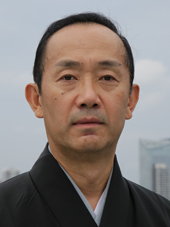
Noh master
Umewaka Naohiko
Trained by his father, Dr. Umekawa started his career as a noh actor at the age of three. Today he also produces and writes original noh plays and collaborates with contemporary dance and performances in and out of Japan. In 2015, Dr. Umewaka starred in a contemporary play Lear Dreaming at the Théâtre de la Ville in Paris in June, and directed the original noh play Ondine at the Maison de la culture du Japon à Paris in December. He was invited to the Al Bustan International Festival of Music and Performing Arts in Beirut to present a contemporary play Do You Noh Shakespeare? King Lear, which he wrote and produced. He received his Ph.D. in 1995 from Royal Holloway, University of London. After teaching as a visiting lecturer at Royal Holloway, and serving as visiting artist at Princeton University, he now holds positions as a professor at Shizuoka University of Arts and Culture, visiting professor at University of Philippines, and part-time lecturer at Keio University International Center. Dr. Umewaka was selected as an Ambassador of Culture in 2008. His publications include Noh e no shotai [An Invitation to Noh] (Iwanami Shoten, 2003).
What is the “Nitobe Leadership Program”?
Archives
Program
Nitobe Leadership Program Leadership and Teamwork Seen Through Judo’s Globalization
Innovation
Leadership Development
Program
Nitobe Leadership Program Co-existing: A Quest for Global Peace
Innovation
Leadership Development


Program
Nitobe Leadership Program US-Japan Relations in a Turbulent Time in Asia
Innovation
Leadership Development

Related Programs

Innovation Asia Leaders Fellowship (ALF)
ALF was established by Teruhide Sato and Lin Kobayashi, both board members of the International House of Japan (IHJ), along with 5 other founding members. Their awareness of the necessity for a dialog...
Intellectual Dialogue
main-300x200.jpg)